Projekt A02: Verstehensprozess einer Erklärung beobachten und auswerten

Wenn Menschen etwas erklärt bekommen, signalisieren sie ihr Verstehen oder Nicht-Verstehen zum einen mit verbalen Äußerungen und zum anderen mit nichtverbalen Kommunikationsmitteln, wie beispielsweise Gestik und Mimik. Wer nickt, kann der erklärenden Person verdeutlichen, dass er*sie verstanden hat. Das Nicken kann aber ebenfalls als Aufforderung gemeint sein, mit einer Erklärung fortzufahren, und ist im Kontext des Gesprächs einzuschätzen. Die Linguist*innen und Computerlinguist*innen untersuchen im Projekt A02, wie Personen – und zukünftig Maschinen – beim Erklären erkennen, dass ihre Gesprächspartner*innen sie verstehen oder nicht verstehen.
In der ersten Förderphase hat das Team ein Dialogkorpus aufgebaut, das vielfältige Feedbacksignale enthält, die als bedeutungsvolle Muster über verschiedene Modalitäten hinweg analysiert werden. Darauf aufbauend untersuchen die Forschenden, wie Erklärungen überwacht und angepasst werden. Zudem wird geprüft, inwiefern diese Erkenntnisse für sozial eingebettete und dynamisch angepasste erklärbare KI nutzbar sind.
Forschungsgebiete: Informatik, Linguistik






Aktuelles aus dem Projekt
Hilfskräfte
Anne Marlene Baumann, Universität Paderborn
Nico Dallmann, Universität Bielefeld
Lena Grosshardt, Universität Paderborn
Ehemalige Mitglieder
Yu Wang, Wissenschaftlicher Mitarbeiter
Poster
Konferenz-Poster präsentiert auf der 10th Conference of the International Society for Gesture Studies mit dem Titel „Different explanation topics, different gestural dimensions?‟ von Stefan Lazarov.
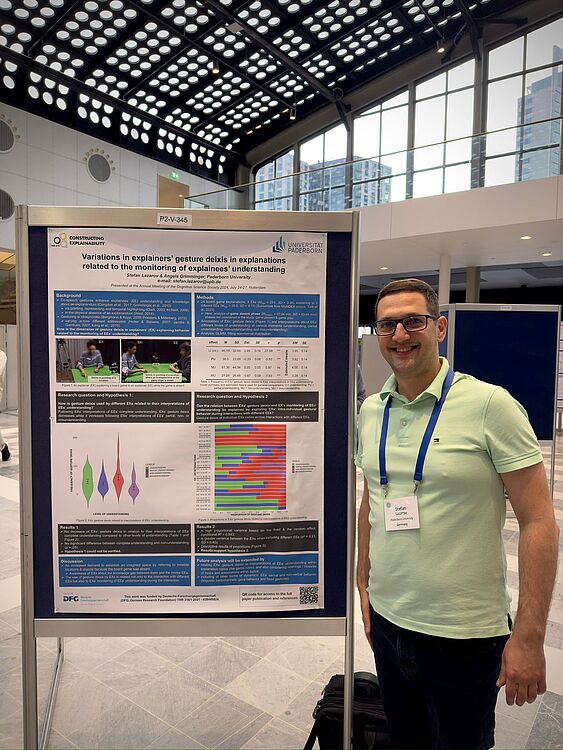
Konferenz-Poster präsentiert auf der CogSci 2024 zur Publikation "Variations in explainer's gesture deixis in explanations related to the monitoring of explainees' understanding" von Stefan Lazarov und Angela Grimminger.
Konferenz-Poster präsentiert auf dem Symposium Series on Multimodal Communication 2023 mit dem Titel "An Unsupervised Method for Head Movement Detection" von Yu Wang und Hendrik Buschmeier.
Konferenz-Poster präsentiert auf dem Symposium Series on Multimodal Communication 2023 mit dem Titel "The relation between multimodal behaviour and elaborartions in exlpanations" von Stefan Lazarov und Angela Grimminger.
Publikationen
Incremental communication
B. Wrede, H. Buschmeier, K.J. Rohlfing, M. Booshehri, A. Grimminger, in: K.J. Rohlfing, K. Främling, S. Alpsancar, K. Thommes, B.Y. Lim (Eds.), Social Explainable AI, Springer, 2026, pp. 227–245.
Theoretical aspects of multimodal processing
A. Grimminger, H. Buschmeier, in: K.J. Rohlfing, K. Främling, S. Alpsancar, K. Thommes, B.Y. Lim (Eds.), Social Explainable AI, Springer, 2026, pp. 351–365.
Characteristics of nonverbal behavior
S.T. Lazarov, I. Tchappi, A. Grimminger, in: K.J. Rohlfing, K. Främling, S. Alpsancar, K. Thommes, B.Y. Lim (Eds.), Social Explainable AI, Springer, 2026, pp. 367–390.
Timing and synchronization of multimodal signals in explanations
P. Wagner, S. Kopp, in: K.J. Rohlfing, K. Främling, S. Alpsancar, K. Thommes, B.Y. Lim (Eds.), Social Explainable AI, Springer, 2026, pp. 433–446.
Practices: How to establish an explaining practice
K.J. Rohlfing, A.-L. Vollmer, A. Grimminger, in: K. Rohlfing, K. Främling, K. Thommes, S. Alpsancar, B.Y. Lim (Eds.), Social Explainable AI, Springer, 2026.
Components of an explanation for co-constructive sXAI
A.-L. Vollmer, H.M. Buhl, R. Alami, K. Främling, A. Grimminger, M. Booshehri, A.-C. Ngonga Ngomo, in: K.J. Rohlfing, K. Främling, B. Lim, S. Alpsancar, K. Thommes (Eds.), Social Explainable AI, Springer, 2026, pp. 39–53.
Predicting states of understanding in explanatory interactions using cognitive load-related linguistic cues
Y. Wang, O. Türk, A. Grimminger, H. Buschmeier, in: Proceedings of the 15th Language Resources and Evaluation Conference, ELRA, Palma, Mallorca, Spain, 2026, pp. 11368–11378.
How are gaze aversions and mutual gaze related to the topical development of dyadic explanatory interactions?
S.T. Lazarov, A. Grimminger, Journal of Nonverbal Behavior (2026).
Investigating the representation of backchannels and fillers in fine-tuned language models
Y. Wang, L. Lao, L. Huang, G. Skantze, Y. Xu, H. Buschmeier, in: Proceedings of the 64th Annual Meeting of the Association for Computational Linguistics, Association for Computational Linguistics, San Diego, CA, USA, 2026, pp. 5319–5348.
Retrospective video recall for analyzing cognitive processes in naturalistic explanations
S.T. Lazarov, M. Schaffer, V. Gladow, H. Buschmeier, H.M. Buhl, A. Grimminger, Behavior Research Methods (n.d.) 29.
When “yeah” means “not quite”: Multimodal detection of backchannels expressing incomplete understanding
O. Türk, S.T. Lazarov, Y. Wang, A. Grimminger, H. Buschmeier, P. Wagner, in: Proceedings of INTERSPEECH 2026, Sydney, Australia, 2026, pp. 4545–4550.
A BFO-based ontological analysis of entities in Social XAI
M. Booshehri, H. Buschmeier, P. Cimiano, in: Proceedings of the 15th International Conference on Formal Ontology in Information Systems, IOS Press, 2025, pp. 255–268.
A BFO-based ontology of context for Social XAI
M. Booshehri, H. Buschmeier, P. Cimiano, in: Abstracts of the 3rd TRR 318 Conference: Contextualizing Explanations, 2025.
SemDial 2025 – Bialogue. Proceedings of the 29th Workshop on the Semantics and Pragmatics of Dialogue
N. Ilinykh, A. Robrecht, S. Kopp, H. Buschmeier, eds., SemDial 2025 – Bialogue. Proceedings of the 29th Workshop on the Semantics and Pragmatics of Dialogue, Bielefeld, Germany, 2025.
MUNDEX Annotations
H. Buschmeier, A. Grimminger, P. Wagner, S.T. Lazarov, O. Türk, Y. Wang, MUNDEX Annotations, LibreCat University, 2025.
The reflection of interactional monitoring in the dynamics of verbal and nonverbal forms of explaining
S.T. Lazarov, The Reflection of Interactional Monitoring in the Dynamics of Verbal and Nonverbal Forms of Explaining, Universitätsbibliothek Paderborn, Paderborn, 2025.
Forms of Understanding for XAI-Explanations
H. Buschmeier, H.M. Buhl, F. Kern, A. Grimminger, H. Beierling, J.B. Fisher, A. Groß, I. Horwath, N. Klowait, S.T. Lazarov, M. Lenke, V. Lohmer, K. Rohlfing, I. Scharlau, A. Singh, L. Terfloth, A.-L. Vollmer, Y. Wang, A. Wilmes, B. Wrede, Cognitive Systems Research 94 (2025).
Acoustic detection of false positive backchannels of understanding in explanations
O. Türk, S.T. Lazarov, H. Buschmeier, P. Wagner, A. Grimminger, in: LingCologne 2025 – Book of Abstracts, 2025, p. 36.
Annotation Schemes Project A02 "Monitoring the understanding of explanations"
S.T. Lazarov, O. Türk, A. Grimminger, P. Wagner, H. Buschmeier, Annotation Schemes Project A02 “Monitoring the Understanding of Explanations,” LibreCat University, 2025.
Towards a BFO-based ontology of understanding in explanatory interactions
M. Booshehri, H. Buschmeier, P. Cimiano, in: Proceedings of the 4th International Workshop on Data Meets Applied Ontologies in Explainable AI (DAO-XAI), International Association for Ontology and its Applications, Santiago de Compostela, Spain, 2024.
Detecting subtle differences between human and model languages using spectrum of relative likelihood
Y. Xu, Y. Wang, H. An, Z. Liu, Y. Li, in: Proceedings of the 2024 Conference on Empirical Methods in Natural Language Processing, ACL, Miami, FL, USA, 2024, pp. 10108–10121.
A model of factors contributing to the success of dialogical explanations
M. Booshehri, H. Buschmeier, P. Cimiano, in: Proceedings of the 26th ACM International Conference on Multimodal Interaction, ACM, San José, Costa Rica, 2024, pp. 373–381.
Conversational feedback in scripted versus spontaneous dialogues: A comparative analysis
I. Pilán, L. Prévot, H. Buschmeier, P. Lison, in: Proceedings of the 25th Meeting of the Special Interest Group on Discourse and Dialogue, Kyoto, Japan, 2024, pp. 440–457.
Turn-taking dynamics across different phases of explanatory dialogues
P. Wagner, M. Włodarczak, H. Buschmeier, O. Türk, E. Gilmartin, in: Proceedings of the 28th Workshop on the Semantics and Pragmatics of Dialogue, Trento, Italy, 2024, pp. 6–14.
Can AI explain AI? Interactive co-construction of explanations among human and artificial agents
N. Klowait, M. Erofeeva, M. Lenke, I. Horwath, H. Buschmeier, Discourse & Communication 18 (2024) 917–930.
Revisiting the phenomenon of syntactic complexity convergence on German dialogue data
Y. Wang, H. Buschmeier, in: Proceedings of the 20th Conference on Natural Language Processing (KONVENS 2024), Vienna, Austria, 2024, pp. 75–80.
How much does nonverbal communication conform to entropy rate constancy?: A case study on listener gaze in interaction
Y. Wang, Y. Xu, G. Skantze, H. Buschmeier, in: Findings of the Association for Computational Linguistics ACL 2024, Bangkok, Thailand, 2024, pp. 3533–3545.
Automatic reconstruction of dialogue participants’ coordinating gaze behavior from multiple camera perspectives
A.N. Riechmann, H. Buschmeier, in: Book of Abstracts of the 2nd International Multimodal Communication Symposium, Frankfurt am Main, Germany, 2024, pp. 38–39.
Variations in explainers’ gesture deixis in explanations related to the monitoring of explainees’ understanding
S.T. Lazarov, A. Grimminger, in: Proceedings of the Annual Meeting of the Cognitive Science Society, 2024.
Towards a Computational Architecture for Co-Constructive Explainable Systems
H. Buschmeier, P. Cimiano, S. Kopp, J. Kornowicz, O. Lammert, M. Matarese, D. Mindlin, A.S. Robrecht, A.-L. Vollmer, P. Wagner, B. Wrede, M. Booshehri, in: Proceedings of the 2024 Workshop on Explainability Engineering, ACM, 2024, pp. 20–25.
Changes in the topical structure of explanations are related to explainees’ multimodal behaviour
S.T. Lazarov, K. Biermeier, A. Grimminger, Interaction Studies 25 (2024) 257–280.
Explain with, rather than explain to: How explainees shape their own learning
J.B. Fisher, K.J. Rohlfing, E. Donnellan, A. Grimminger, Y. Gu, G. Vigliocco, Interaction Studies 25 (2024) 244–255.
Predictability of understanding in explanatory interactions based on multimodal cues
O. Türk, S.T. Lazarov, Y. Wang, H. Buschmeier, A. Grimminger, P. Wagner, in: Proceedings of the 26th ACM International Conference on Multimodal Interaction, San José, Costa Rica, 2024, pp. 449–458.
The illusion of competence: Evaluating the effect of explanations on users’ mental models of visual question answering systems
J. Sieker, S. Junker, R. Utescher, N. Attari, H. Wersing, H. Buschmeier, S. Zarrieß, in: Proceedings of the 2024 Conference on Empirical Methods in Natural Language Processing, ACL, Miami, FL, USA, 2024, pp. 19459–19475.
Does listener gaze in face-to-face interaction follow the Entropy Rate Constancy principle: An empirical study
Y. Wang, H. Buschmeier, in: Findings of the Association for Computational Linguistics: EMNLP 2023, Singapore, 2023, pp. 15372–15379.
Modeling Feedback in Interaction With Conversational Agents—A Review
A. Axelsson, H. Buschmeier, G. Skantze, Frontiers in Computer Science 4 (2022).
Alle Publikationen anzeigen