Projekt A03: Ko-Konstruktion von Erklärungen zwischen KI-Erklärer*in und menschlichen Erklärungsempfänger*innen mit und ohne Erregung

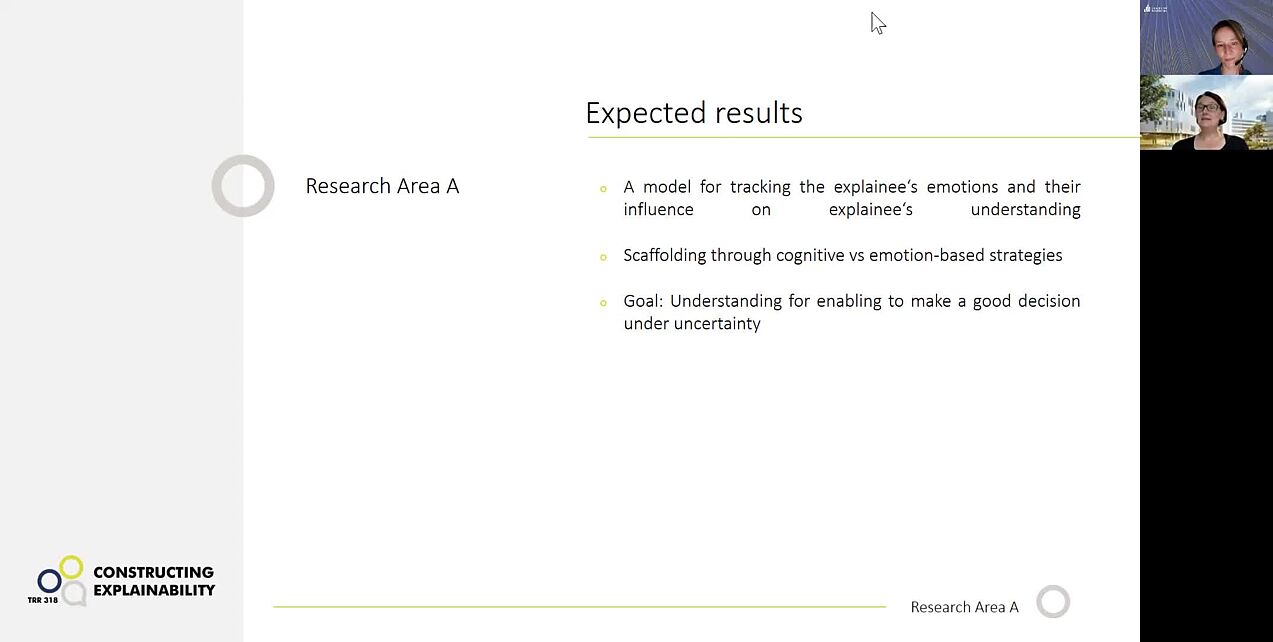
Im Projekt A03 wird der Einfluss von Emotionen auf Erklärprozesse untersucht, insbesondere die Frage, wie Erregung die Verarbeitung von Erklärungen beeinflusst. Ziel des Projektteams ist die Entwicklung eines interaktiven Systems, das es den Nutzenden ermöglicht, KI-Erklärungen auch dann zu verstehen, wenn sie stark oder schwach erregt sind. Zu diesem Zweck soll das System sowohl für sich selbst als auch für die Nutzenden sichtbar machen, wie Erregung die Rezeption von Empfehlungen und deren Erklärungen beeinflusst, und gezielte Eingriffe in diesen Prozess ermöglichen.
Forschungsgebiete: Informatik, Wirtschaftswissenschaften




Aktuelles aus dem Projekt
Assoziiertes Mitglied
Dr.-Ing. Birte Richter, Universität Bielefeld
Hilfskräfte
Eileen Behrens, Universität Bielefeld
Florian Risse, Universität Paderborn
Aenna-Malin Geist, Universität Paderborn
Celine Porz, Universität Paderborn
Ehemalige Mitglieder
Dr. Olesja Lammert, Wissenschaftliche Mitarbeiterin
Christian Schütze, Wissenschaftlicher Mitarbeiter
Publikationen
Incremental communication
B. Wrede, H. Buschmeier, K.J. Rohlfing, M. Booshehri, A. Grimminger, in: K.J. Rohlfing, K. Främling, S. Alpsancar, K. Thommes, B.Y. Lim (Eds.), Social Explainable AI, Springer, 2026, pp. 227–245.
Generation of Explanatory Content and Requirements for Social XAI
K. Främling, K. Thommes, B. Wrede, in: Social Explainable AI, Springer Nature Singapore, Singapore, 2026.
Measuring the Outcome of sXAI
K. Thommes, in: Social Explainable AI, Springer Nature Singapore, Singapore, 2026.
Operationalizing Social Interaction
H. Wachsmuth, K. Thommes, M. Alshomary, in: Social Explainable AI, Springer Nature Singapore, Singapore, 2026.
Exploration of Explaining Content
K. Främling, B. Wrede, K. Thommes, in: Social Explainable AI, Springer Nature Singapore, Singapore, 2026.
Interaction History in Social XAI
K. Thommes, K. Främling, B. Wrede, S. Kubler, in: Social Explainable AI, Springer Nature Singapore, Singapore, 2026.
Evaluation Principles
K. Thommes, in: Social Explainable AI, Springer Nature Singapore, Singapore, 2026.
Are numerical or verbal explanations of AI the key to appropriate user reliance and error detection?
J. Papenkordt, A.-C. Ngonga Ngomo, K. Thommes, Behaviour & Information Technology (2025) 1–22.
Can AI Regulate Your Emotions? An Empirical Investigation of the Influence of AI Explanations and Emotion Regulation on Human Decision-Making Factors
O. Lammert, in: Communications in Computer and Information Science, Springer Nature Switzerland, Cham, 2025.
Forms of Understanding for XAI-Explanations
H. Buschmeier, H.M. Buhl, F. Kern, A. Grimminger, H. Beierling, J.B. Fisher, A. Groß, I. Horwath, N. Klowait, S.T. Lazarov, M. Lenke, V. Lohmer, K. Rohlfing, I. Scharlau, A. Singh, L. Terfloth, A.-L. Vollmer, Y. Wang, A. Wilmes, B. Wrede, Cognitive Systems Research 94 (2025).
Humans in XAI: Increased Reliance in Decision-Making Under Uncertainty by Using Explanation Strategies
O. Lammert, B. Richter, C. Schütze, K. Thommes, B. Wrede, Frontiers in Behavioral Economics (2024).
Human Emotions in AI Explanations
K. Thommes, O. Lammert, C. Schütze, B. Richter, B. Wrede, in: Communications in Computer and Information Science, Springer Nature Switzerland, Cham, 2024.
Static Socio-demographic and Individual Factors for Generating Explanations in XAI: Can they serve as a prior in DSS for adaptation of explanation strategies?
C. Schütze, B. Richter, O. Lammert, K. Thommes, B. Wrede, in: HAI ’24: Proceedings of the 12th International Conference on Human-Agent Interaction, ACM, 2024, pp. 141–149.
Human Emotions in AI Explanations
K. Thommes, O. Lammert, C. Schütze, B. Richter, B. Wrede, in: 2024.
Towards a Computational Architecture for Co-Constructive Explainable Systems
H. Buschmeier, P. Cimiano, S. Kopp, J. Kornowicz, O. Lammert, M. Matarese, D. Mindlin, A.S. Robrecht, A.-L. Vollmer, P. Wagner, B. Wrede, M. Booshehri, in: Proceedings of the 2024 Workshop on Explainability Engineering, ACM, 2024, pp. 20–25.
The Role of Response Time for Algorithm Aversion in Fast and Slow Thinking Tasks
A. Lebedeva, J. Kornowicz, O. Lammert, J. Papenkordt, in: Artificial Intelligence in HCI, 2023.
RISE: an open-source architecture for interdisciplinary and reproducible human–robot interaction research
A. Groß, C. Schütze, M. Brandt, B. Wrede, B. Richter, Frontiers in Robotics and AI 10 (2023).
EEG Correlates of Distractions and Hesitations in Human–Robot Interaction: A LabLinking Pilot Study
B. Richter, F. Putze, G. Ivucic, M. Brandt, C. Schütze, R. Reisenhofer, B. Wrede, T. Schultz, Multimodal Technologies and Interaction 7 (2023).
Emotional Debiasing Explanations for Decisions in HCI
C. Schütze, O. Lammert, B. Richter, K. Thommes, B. Wrede, in: Artificial Intelligence in HCI, 2023.
What is Missing in XAI So Far?
U. Schmid, B. Wrede, KI - Künstliche Intelligenz 36 (2022) 303–315.
Which “motionese” parameters change with children's age? Disentangling attention-getting from action-structuring modifications
K. Rohlfing, A.-L. Vollmer, J. Fritsch, B. Wrede, Frontiers in Communication 7 (2022).
An Architecture Supporting Configurable Autonomous Multimodal Joint-Attention-Therapy for Various Robotic Systems
A. Groß, C. Schütze, B. Wrede, B. Richter, in: INTERNATIONAL CONFERENCE ON MULTIMODAL INTERACTION, ACM, 2022, pp. 154–159.
Enabling Non-Technical Domain Experts to Create Robot-Assisted Therapeutic Scenarios via Visual Programming
C. Schütze, A. Groß, B. Wrede, B. Richter, in: INTERNATIONAL CONFERENCE ON MULTIMODAL INTERACTION, ACM, 2022, pp. 166–170.
Alle Publikationen anzeigen