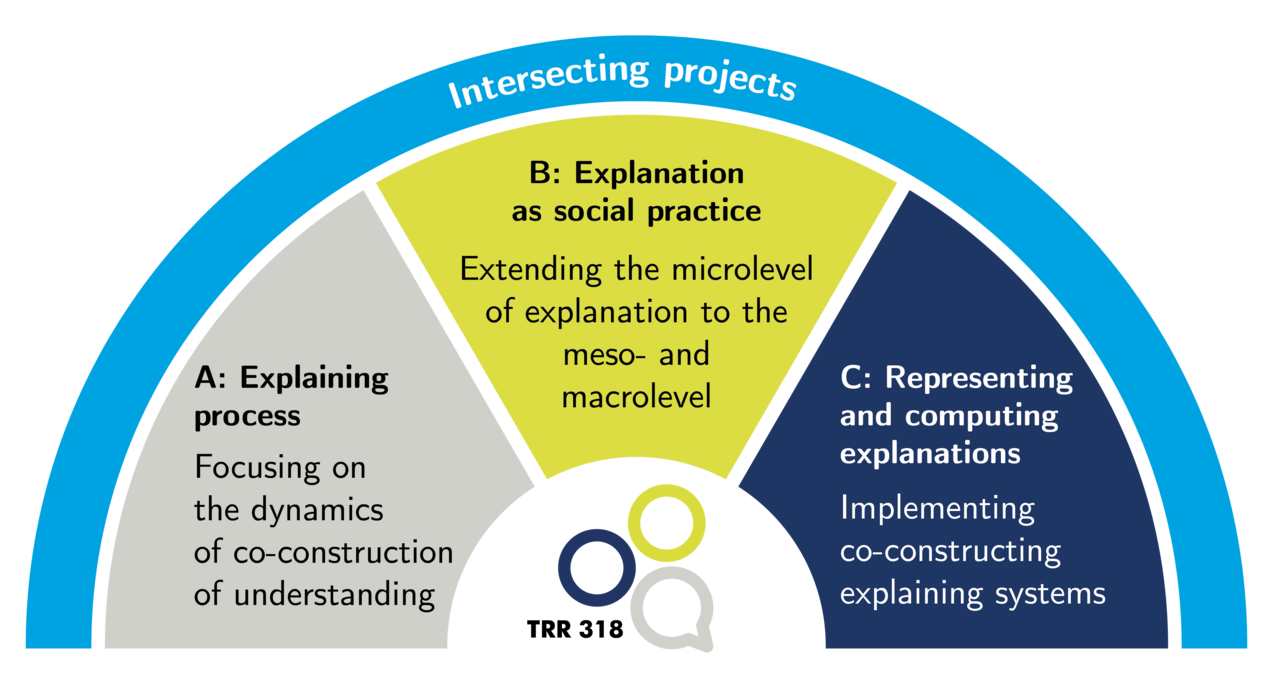
Research profile of TRR 318
Algorithmic approaches such as machine learning are becoming increasingly complex. This growing opacity makes it difficult to understand and accept the decisions proposed by artificial intelligence (AI). In response to this societal challenge, computer scientists have begun to develop self-explanatory algorithms that provide explanations in an intelligent way (eXplainable Artificial Intelligence, XAI). However, these programs have so far only interacted with humans to a limited extent and do not take into account the information needs of the addressee or the respective context. This creates the risk of generating explanations that are not understood.
The members of Transregio (TRR) 318 question this view and pursue a co-construction of explanations: explainees should actively participate in the explanation process by helping to shape its goal and course.
In the first funding phase (2021-2025), around 60 scientists conducted theoretical and empirical basic research to understand explanatory processes and the involvement of explainees in human-human and human-AI interactions. The results led to new insights into how explanatory dialogues are structured in everyday situations, how understanding develops in conversation, and how AI explanations can be flexibly adapted. On this basis, the first XAI systems were developed that actively involve users and adapt the explanation process step by step in a co-constructive manner. In addition, the project investigated whether and in which situations users value understanding the functioning and results of AI. The results show that explanation needs are diverse and can even change dynamically within a single interaction.
For the second funding phase (2026-2029/1), the focus will be on the relevance of explanations in situational contexts – not only with regard to user expectations, but also in terms of their professional roles, normative requirements, specific tasks, previous interactions, and other influencing factors. Therefore, in the future, explanatory algorithms should be better equipped to construct relevant contexts together with users and to determine the factors that are decisive for this. This co-construction of context requires a more explicit, detailed, and interaction-oriented framework than has been customary in the field of XAI to date.
With this focus on the active involvement of users and the social aspects of explanation, TRR 318 is laying the foundation for a paradigm of social XAI (sXAI). The interactive sXAI approach reduces the burden on users by deriving relevant contextual factors directly from the interaction. The context itself thus becomes a co-constructed component of the interaction.
The mechanisms of explainability, explanations, and context are being investigated by about 75 researchers in an interdisciplinary collaboration: They conduct research in the fields of computer science, linguistics, media studies, philosophy, psychology, sociology, and economics.
The findings of the research efforts from TRR 318 will contribute to the development of:
- a multidisciplinary understanding of the explanation process, which is closely linked to comprehension processes and relevant contextual factors,
- computer models and complex AI systems that generate explanations efficiently and in a manner appropriate to the addressee in the current context, and
- a theory of explanations as social practices that takes into account the expectations and roles of communication partners.
The research areas of TRR 318 are divided into
B “Explanation as social practice” and
C “Representing and computing explanations”.
These areas are further divided into interdisciplinary subprojects.
Overall, the INF project creates a research structure, the WIKO project promotes exchange with the public, the Z project is responsible for organization and finances, and the RTG project is responsible for the qualification of doctoral students and postdocs.
In addition, the scientists of TRR 318 have formed synthesis groups to work together on central and current research topics from different disciplinary perspectives.