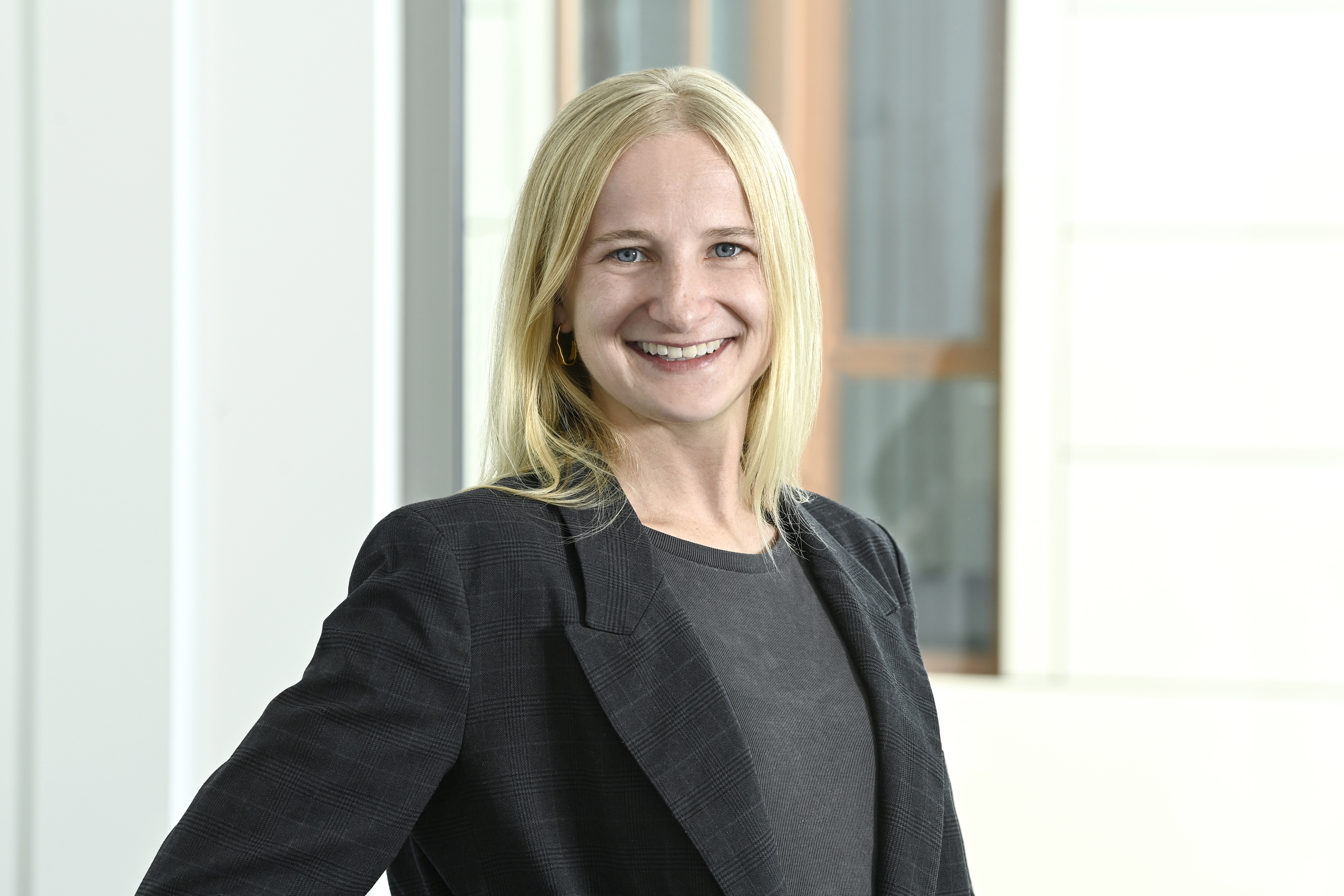
Text: Jana Haver
TRR 318’s graduate school provides a structured training program for doctoral researchers and post-doctoral researchers. Ricarda Kurock is the coordinator of the Research Training Group (RTG). In the following interview, she speaks about the offerings, goals, and success of the program. A key element for her is the cooperative, interdisciplinary approach.
What is the goal of the Transregio’s Graduate School?
Ricarda Kurock: Our mission is the further education of researchers who are associated with TRR 318 or who are employed there. We support doctoral and post-doctoral researchers in their work during early career stages by providing them, on the one hand, with deep insight into the various disciplines, and on the other hand, by helping researchers develop the skills to participate productively in interdisciplinary collaboration.
How does this interdisciplinarity manifest in the RTG?
Ricarda Kurock: Interdisciplinary collaboration is at the heart of everything we do; it’s not just an add-on. Our researchers come from a wide range of disciplines—from linguistics and psychology to computer science—and collaborate closely. Interdisciplinarity can be extremely productive when, for instance, theories or methods from different disciplinary perspectives are brought together. Indeed, interdisciplinarity offers many opportunities, but it also poses challenges. For example, if two people are talking about a tree and one person is thinking of a pine tree and the other of a broadleaf tree, but this is not communicated, it can quickly lead to misunderstandings. This sometimes happens when different disciplines come together. That’s why it’s so important for us empower early career researchers to successfully navigate such processes.
How is the Transregio’s RTG structured and what services are available?
Ricarda Kurock: An essential part is the workshop program where personal and professional skills are honed. We also offer various events and counselling services. Our writing day events and retreats, which provide a shared space for academic writing structured by our writing consultant, Andrea Karsten, are particularly popular. We are also committed to providing individual support to early career researchers at TRR. We hold annual development meetings with our doctoral researchers to review their contributions to the research being done at TRR, but also to reflect on their own personal development. Beyond this, we also offer mentoring and networking opportunities. Another important function of the RTG is to provide financial and social support, such as for research trips abroad.
You mentioned networks that early career researchers can build and use. What exactly do you mean by that?
Ricarda Kurock: The aim of the RTG is to foster a close-knit community of research practitioners. The focus here is on networking—with each other, but also externally. Early career researchers from different disciplines and projects can come together and exchange ideas through the RTG. But there is also external input. We hold regular events where we invite various people to speak on specific topics, for instance, former academics who are now working outside of academia. With these kinds of offerings, we want to highlight different career paths. Talks on experiences abroad are also popular. For example, we invited an assistant professor to discuss her experiences working in the US and answer questions about it.
To what extent can early career researchers pursue experiences abroad themselves?
Ricarda Kurock: We fund research stays abroad. So far, around 15 researchers have already done a research stay abroad, at locations ranging from Copenhagen to Australia. We also support doctoral researchers who want to visit the Transregio: we have hosted guests from Germany, Italy, Poland, and the Netherlands.
How successful is the RTG? How many researchers have been educated there?
Ricarda Kurock: Most of the doctoral students are currently in the final spurt of their doctorate; we cannot yet say who will finish when. We continuously evaluate our program in order to provide the best possible offerings. Our writing retreats are very popular: a group of early careers researchers go to a hotel where they can get support on the writing process and have the opportunity to work on their individual projects. The structure and the shared setting give participants both autonomy and social connection, the combination of which is very motivating. Here researchers are not only supported in their writing, but also talk to each other and share their experiences. There are writing retreats on the calendar in the coming months.
What are the skills and abilities that doctoral researchers get from the RTG, above and beyond what they’re learning from the content of their own projects?
Ricarda Kurock: The greatest strength of the RTG really lies in interdisciplinary exchange. Different perspectives and methodological approaches come together. Concepts are discussed and further developed in ways that would not be possible without exposure to this diversity of viewpoints. The methodological approaches are also often very different. RTG members are constantly encouraged to communicate with each other, to refine their own point of view, to develop a sense of openness towards other perspectives, and to make compromises. I think that this is of great value. And because we communicate in English, this is of course also a skill for the international job market.
How can prospective students become part of the RTG?
Ricarda Kurock: Researchers who are employed in TRR 318 and are in an early funding phase, i.e. doctoral and post-doctoral researchers, are automatically part of the RTG. External doctoral researchers or students can also apply if they are working on a TRR-related topic.
What’s up next for the RTG in the next phase of funding?
Ricarda Kurock: We hope that the RTG and TRR 318 as a whole will be able to secure a second round of funding. We gained a lot of experience at the beginning and were able to optimize some aspects quite well. This is why we would like to continue and contribute the knowledge we have gained and further expand the network we have already established.
What does the RTG and your work there mean to you personally?
Ricarda Kurock: I’ve been at the RTG for approximately two years. I am currently training to become a systemic counselor. Counseling always requires a bit of relationship work, so it took some time to get to know the members and understand their needs. But everything is going very well now. I really enjoy my work and I think it’s great to see how our service offerings are being used and how the researchers are developing. I am delighted to be able to support them.
Note: This article is from the TRR 318 brochure published in summer 2025.